Blog

  • Small Wins Change Lives

    Most people think life changes in dramatic moments.

    A promotion.

    A diagnosis.

    A wedding.

    A divorce.

    A financial windfall.

    But the older I’ve become, the more I realize that life rarely changes because of one single event. More often than not, life is shaped by small decisions repeated over time.

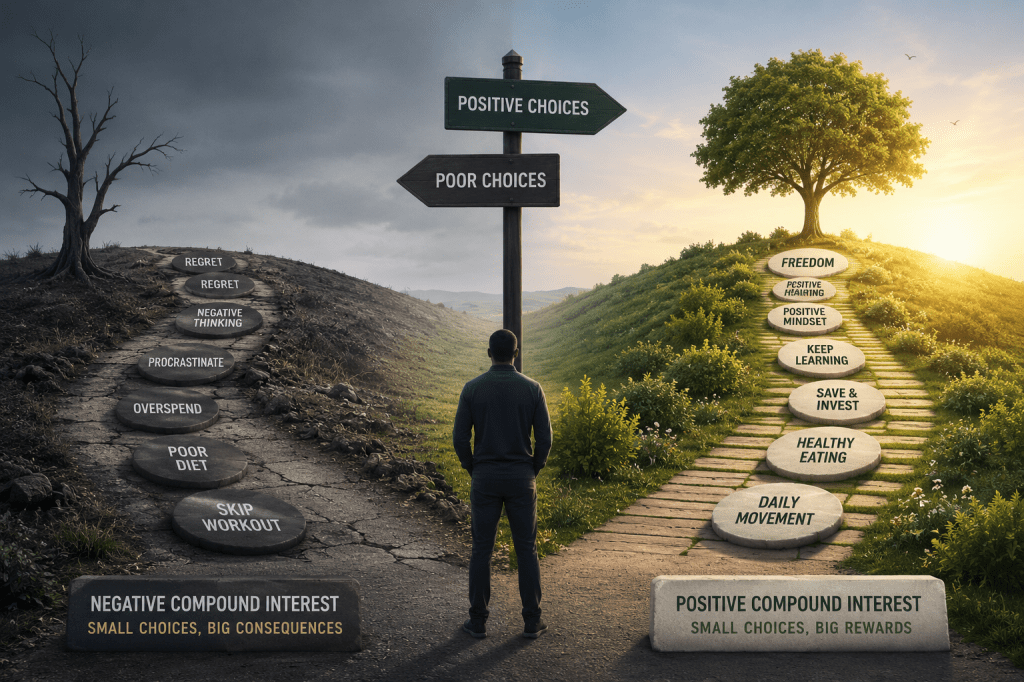
    Just as compound interest quietly grows an investment account, our daily choices compound into the lives we eventually live.

    The reality—and the challenge—is that compound interest works both ways.

    Good decisions accumulate benefits.

    Poor decisions accumulate consequences.

    The walk we take today may seem insignificant. The walk we skip today may seem insignificant too. Yet neither decision exists by itself.

    They are both earning interest.

    You Have a Nice Butt

    I ran track at Manual High School back in 19-something… well, let’s just leave the year at that.

    I was mainly a long jumper.

    Truth be told, my status as a great runner didn’t begin in high school. It started back in elementary school at St. James. I loved running, but more than that, I loved being chased.

    Picture this: a third grader runs by and somewhat gently slaps another kid on the face; that depending on what kid was being slapped. That kid starts chasing him, so while being chased, the slapper goes ahead and slaps another kid… and another… and another… all while dodging the growing crowd behind him.

    It was all in good fun… at least that’s how I remember it.

    I loved running. I loved long walks. I loved even longer bicycle rides. But mostly, I loved running.

    When my mother would walk from 17th Avenue and Monaco all the way to Colorado Boulevard and back, I wasn’t walking beside her. I was running ahead, turning around, running back to her, then taking off again.

    In the words of Forrest Gump, “If I was going somewhere, I was running.”

    Although I was fast, and one of the runners to beat for bragging rights around Park Hill, I still didn’t have proper sprinting form in high school.

    Coach Burrell constantly worked with me on coming out of the starting blocks. We did kickbacks, high knees, 200-meter sprints, and long runs around City Park Golf Course.

    Sometimes those runs got even longer.

    One day, Coach Burrell caught me smoking a cigarette behind the school. He pulled up in his truck, rolled down the window, and simply said, “Hit the park.”

    After what felt like forever, he told me, “If I ever catch you smoking again, you won’t run for me.”

    Looking back, I appreciated him for that.

    He gave me another chance, but he also taught me something I’ll never forget:

    If you’re committed to becoming something, you can’t keep doing things that work against it.

    Then came the last day of school.

    Everyone was cleaning out their lockers.

    I bent over to pick up a few books when I heard a girl behind me say, “Don’t move.”

    She called another girl over.

    They both looked.

    One of them smiled and said, “You have a nice butt.”

    Well…

    I was skinny, but I was in great shape.

    I got her phone number.

    We became good friends.

    Not a bad return on all those miles.

    Baby?

    Years passed, and things changed, as they always do.

    I still stayed in shape but not as much as I would have liked.

    It wasn’t that I wasn’t committed. Life got in the way.

    I was a single father raising two boys, and whenever I got the chance—which seemed to be just about every weekend—I would PARTY!!!

    If it wasn’t a house party, it was the club. When the club closed, it was the after-hours club. Sometimes it was the motorcycle club, where they knew you were underage but let you in anyway.

    I took up smoking again. And if you’ve ever had hard liquor and beer, you know the chaser was almost always a cigarette.

    Before heading to the club, I’d stop and buy a pack of menthol Kool Filtered Kings or Newports. By the time the night was over, so was most of that pack.

    Looking back now, I’m so thankful I quit smoking in 2007.

    But cigarettes weren’t my only bad habit.

    It was also what I was putting into my body.

    Carbs.

    Red meat.

    Foods loaded with sodium.

    Cake.

    Ice cream.

    And don’t even get me started on Krispy Kreme doughnuts.

    Every doctor’s visit seemed to include the same conversation.

    “Your triglycerides are high.”

    “They’ll come down with exercise and a better diet.”

    So I’d work out hard… for about a week.

    I’d play long basketball games after drinking a 40-ounce bottle of Old English 800 Malt Liquor with a few friends.

    Crazy, right?

    The funny thing is, I still had game.

    Man, I remember playing in the blazing summer heat, putting up points with my “okie-doke” shots—that’s what my friends called them.

    What I didn’t realize was that while I was still able to perform, my body was quietly keeping score.

    The damage wasn’t instant. It was accumulating.

    One poor choice after another.

    One skipped opportunity after another.

    One unhealthy habit earning interest.

    Then one day, my youngest son looked at my stomach.

    He tilted his head.Looked again.Then asked one word.

    “Baby?”

    He was completely serious.

    I couldn’t even be mad.

    That one word said more than any doctor’s report ever had.

    Those years of accumulated choices eventually showed up as moderate visceral fat, prediabetes, poor sleep, and other health challenges.

    Thankfully, compound interest works in reverse too.

    That’s when I decided it was time to start making deposits into my health instead of withdrawals.

    But seriously…

    “Baby?”

    I still laugh about that one.

    The Results of Repeated Choices

    It wasn’t the word “Baby” that stayed with me. It was what that one word revealed.

    Somewhere along the way, I had accumulated enough visceral fat around my abdomen that my youngest son honestly thought I looked pregnant. At least he didn’t ask if I was having twins.

    Could it be fixed? Absolutely.

    But it would come at a cost.

    Then again, getting there had come at a cost too.

    Every choice has a price. Some choices require us to pay now and enjoy the reward later. Others feel good in the moment but quietly send us the bill years down the road.

    Whether we’re talking about our health, finances, relationships, or character, our daily decisions are always earning interest.

    The question isn’t whether there will be a cost. The question is when we’ll pay it, and whether we’ll be grateful we did.

    The Next Deposit

    The older I get, the more I realize that life is rarely changes by one big decision. It’s changes by thousands of small ones.

    A promotion. A healthy marriage. A strong body. Financial freedom. A meaningful relationship with your children. None of these happen overnight. They are the results of small deposits made over weeks, months, and years.

    Today you have an opportunity to make another deposit.

    Maybe it’s taking a walk instead of watching another hour of television.

    Maybe it’s putting twenty dollars into savings.

    Maybe it’s making the phone call you’ve been avoiding.

    Maybe it’s choosing forgiveness.

    Whatever it is, don’t underestimate it.

    The future you’re hoping for isn’t built in a single day. It’s built one decision, one habit, and one deposit at a time.

    Small wins really do change lives.

    So I’ll leave you with one question:

    What deposit will you make today?
  • The Fingernail

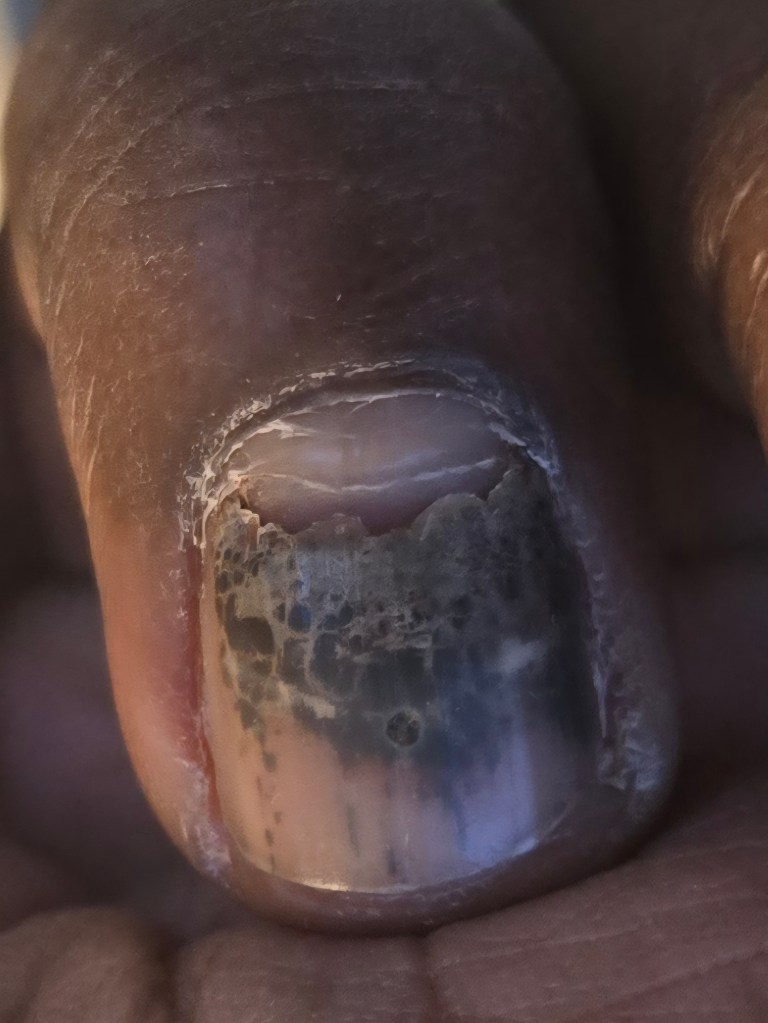
    Wanna see something painfully ugly? Not to mention the dry skin. Ugh.

    On February 2, 2025, my son John Jr. came upstairs and told me, “Dad, it’s getting ready to snow outside.”

    There was a very light drizzle, and I didn’t want to have to scrape the windows in the morning, so I pulled out the handy SubZero ArcticDefense MAXX Windshield Cover that I had purchased from Sam’s Club.

    I had the driver’s side door open so I could tuck one of the cover’s flaps inside the door. The idea is simple: shut the door on the flap, and it stays securely in place overnight.

    As I reached over with my left hand to close the door, my right finger got caught at the top of the door frame.

    Curses. Curses and more curses.

    A sharp pain shot through my finger instantly. My first instinct was to jerk my hand free, but I knew that would probably make things worse. My right index finger was trapped between the top of the driver’s side door and the frame, with the door completely shut.

    Fear hit first.

    What the heck had I just done to my finger?

    Then came anger. Not at anyone in particular, just anger that it had happened at all. My right hand—my dominant hand—was pinned in place, and the door handle was just far enough away that I couldn’t reach it.

    Awkwardly, I stretched my left hand across my stomach, reached for the handle, and pulled the door open.The moment the pressure released, the throbbing began.

    For a brief moment, I blamed it on my son.

    After all, it didn’t even really snow.

    My son’s prediction turned out to be right. He told me the nail would turn black, and he genuinely felt bad for me.

    By the next day, my finger was black and swollen to what seemed like more than half its normal size, so I went to urgent care.

    The X-rays showed no broken bones, which was a relief. The doctor then performed a procedure called nail trephination, drilling a tiny hole through the nail to release the blood that had built up underneath it. That’s the little circle you can see in the picture above.

    The relief was almost immediate.

    That tiny hole sure did help.

    Change Takes Time

    About ten days later, my fingernail still wasn’t winning any beauty contests.

    In fact, if you looked at it from the outside, it didn’t seem like much had changed at all. The damaged portion of the nail was still there, dark and unattractive. But something important was happening beneath the surface.

    A new nail had already begun to grow.

    What I learned is that fingernails grow from an area beneath the cuticle called the nail matrix. As the new nail forms, it slowly pushes the damaged nail forward until the old nail eventually grows out and is replaced.

    The interesting part is that the process isn’t instant.

    The damaged nail doesn’t simply disappear overnight. For a period of time, the old and the new exist together. The healthy nail is growing, but the evidence of the injury is still visible.

    Life often works the same way.

    Many of us want change to happen immediately. We want the new habit, the new mindset, the new career, the improved health, the restored relationship, or the better life to appear overnight. But meaningful change usually happens beneath the surface long before anyone can see it.

    The fingernail reminded me of braces.

    Anyone who has worn braces knows that the process isn’t always comfortable. Every adjustment by the orthodontist creates pressure. Sometimes your teeth ache for days afterward. Yet that discomfort serves a purpose. The teeth are gradually being moved into proper alignment.

    The goal isn’t the temporary discomfort. The goal is the finished result.

    In the same way, growth often comes with pressure. Change can be uncomfortable. Sometimes it can even be painful. But discomfort does not mean that progress isn’t taking place.

    Sometimes the discomfort of change shows up in our relationships.

    As we grow, our priorities change. We begin to value different things. We may become more intentional with our time, our health, our faith, our finances, or our purpose. When that happens, some relationships naturally change as well.

    That doesn’t mean the other person is bad, and it doesn’t mean either of you did something wrong.

    Sometimes people simply grow in different directions.

    A friend who was a perfect fit for one season of your life may not be the right fit for the next. The conversations no longer inspire you. The goals no longer align. The places you want to go and the person you are trying to become may be different from where they want to go.

    That realization can be uncomfortable.

    There can be sadness in creating distance from people you genuinely care about. There can be guilt. There can be loneliness. There can even be moments when you question whether you’re making the right decision.

    But growth often requires making room for what comes next.

    Just as the new nail slowly pushes the damaged nail forward, sometimes personal growth gently pushes us toward new environments, new opportunities, and new relationships that better align with who we are becoming.

    The process isn’t always easy, but it is often necessary.

    Just because we can’t immediately see the results doesn’t mean the process isn’t working.

    Sometimes the new version of ourselves is already growing beneath the surface, slowly pushing the old version away.

    Trusting the Process

    As I write this, my fingernail is completely back to normal.

    The new nail continued to grow, slowly pushing the damaged portion forward. Week by week, the old nail had less space to occupy, and the healthy nail had a little more.

    That’s how change often works.

    We want transformation to happen quickly. We want the new job, the healthier body, the repaired relationship, the completed book, or the fulfilled dream to arrive immediately. Instead, change usually arrives a little at a time.

    The challenge is that we often judge the process too early.

    We look at our lives and see the damaged nail. We focus on what isn’t finished, what still hurts, or what hasn’t changed yet. What we fail to notice is that something new may already be growing beneath the surface.

    The fingernail never fought the process. It simply continued growing.

    Perhaps there is wisdom in that.

    Sometimes our job isn’t to force change. Sometimes our job is to trust the process, remain patient, and keep moving forward one day at a time.

    Eventually, what is healthy replaces what was damaged.

    Eventually, what is new replaces what is old.

    And eventually, if we stay committed to the process, growth becomes visible to everyone.

  • Nothing Is Perfect

    Sometimes when I start something, it has to go the way I want it to go, right down to the very last detail.

    For example, when writing this first post, I imagined it being something entirely different. I pictured a different story, different pictures, a great structure, and even the right type of music playing in the background while I wrote. If I had gone with that idea, it probably would have taken much longer to get this post written. Life gets in the way. Distractions happen. Before I knew it, this first post—hopefully the first of many—could have taken days, weeks, or even months before it was ever written.

    Call it procrastination or whatever you want, but don’t call it laziness. Not for me. Laziness is far from who I am.

    The problem is that I get caught up in the thought of the project, the fascination of it, and all the possibilities of what it could become. I spend so much time imagining the finished product that the actual work never gets done.

    For many years, I have wanted to write books, screenplays, and other creative projects. Year after year, I would set goals, come up with new ideas, purchase new software, purchase new hardware, and convince myself I was making progress. Yet somehow, I never seemed to get any closer to the part that mattered most: writing the sentence, then the paragraph, then the page, then completing, editing, and rewriting the work I envisioned.

    What Perfection Sounds Like

    Perfection is the inner voice that says; “Not ready. Not good enough. Not the right time.” It keeps us waiting for the perfect moment, the perfect plan, or the perfect vision of ourself before we begin.

    A friend once told me before the coronavirus pandemic that if I didn’t complete my project – my book – that year, I would never get it done. I remember later thinking, “Did he just put some kind of curse on me?” I know he meant well and was probably trying to encourage me, but as that year passed, and then the next, and the next, nothing completed. It became a battle of will, a determination not to allow his words to become my reality.

    Looking back, there were many reasons for the delay. Life happened. Work demanded attention. Family concerns pulled me in different directions. Fear and self-doubt played their part as well. But underneath many of those reasons was something I didn’t fully recognize a the time: perfectionism.

    I told myself I was waiting for more time, more clarity, or a better plan. In reality, I was often waiting for the work to feel easier.

    I spent a hell of a lot of money playing the lottery. I analyzed past number patterns, experimented with wheeling systems, and even traveled to stores outside the Denver area—and sometimes out of state—in hopes of hitting a jackpot. In my mind, that win would solve everything. I wouldn’t have to work. I could devote myself entirely to writing and pay for the services of some of the most notable writing instructors, people far beyond what I saw advertised in MasterClass ads.

    With that lottery win, I would finally have the time and freedom to perfect my craft.

    The problem was that reality kept getting in the way of the fantasy.

    When I look back, I realize I already had opportunities. I had vacation days set aside for writing. I had ideas. I had notebooks. I had unfinished pages. Yet when those writing days arrived, very little happened. I wasn’t really waiting for money. I wasn’t really waiting for more time. I was waiting for some future version of myself to show up fully formed and worthy enough to begin.

    What I failed to see was that perfection had disguised itself as preparation. It convinced me that if I couldn’t do it well enough, I shouldn’t do it at all. The result was not better work—it was no work.

    Reflections in the Park

    The other day I went walking with my mother in Fred Thomas Park. I make it a priority to spend time with her and enjoy her company. She is ninety-two years old and has several health issues, one of which is dementia.

    Over time, I have learned to simply be present with her. To enjoy the sunshine, appreciate the beauty around us, and value her company. I have learned not to look at my watch or replay a list of things I need to get done or would like to do. Just be with her in that moment.

    The moment isn’t perfect. There are distractions, worries, and unknowns. Yet it’s real. It’s enough. And it matters.

    Nature doesn’t strive for perfection. It doesn’t worry about being enough. It simply exists, beautiful in its own way.

    If there is one thing I can leave you with from this writing, it is this: get out into nature as often as you can. Take a walk. Sit beneath a tree. Watch a sunset. And if you’re fortunate enough to do it with someone you love, don’t spend the time wishing the moment were different. Be there for it. One day you’ll realize that what made the moment special was never its perfection—it was your presence.

    Redefining “Perfect”

    Maybe perfect isn’t flawless. Maybe it’s meaningful, like the moments spent with my mom.

    I remember going camping with my son, John Jr. It was his idea, and I thought it was a great one. But nature being nature, it started raining. The fire pit we were counting on had trouble staying lit, and things weren’t going according to plan.

    I could see his frustration. What he had imagined as the perfect night was slowly turning into disappointment because of things completely outside of his control. But he didn’t quit.

    We took a walk, and during that time I told him how proud I was of him. We talked, laughed, and eventually made the best of the situation. In the end, it turned out to be a great time after all.

    Looking back, I don’t remember the rain nearly as much as I remember being there with my son. The night wasn’t perfect, but it was meaningful. And maybe that’s the point. The moments we remember most are often not the flawless ones, but the imperfect ones that remind us what really matters.

    Choosing Progress over Perfection

    From now on, I’m not waiting for perfect. I’m choosing progress.

    Recently, I was listening to Be Your Future Self Now by Benjamin Hardy on Audible. Several ideas in the book caught my attention, but one stood out more than the others. Hardy makes the point that staying on the sidelines may feel safe, but over time it can become one of the greatest sources of regret.

    That hit home for me.

    For years, I have spent time thinking, planning, researching, dreaming, and preparing. Some of that was necessary. Some of it was valuable. But some of it was simply a way of avoiding the discomfort of beginning.

    The truth is that life is not waiting for me to be ready. It is moving forward whether I act or not.

    So this post is my reminder to myself as much as it is to anyone reading it. I don’t need the perfect idea, the perfect outline, the perfect software, the perfect music, or the perfect circumstances.

    I just need to begin.

    And maybe that’s true for you too.

    You and I don’t need perfect to be in the game. We just need to start